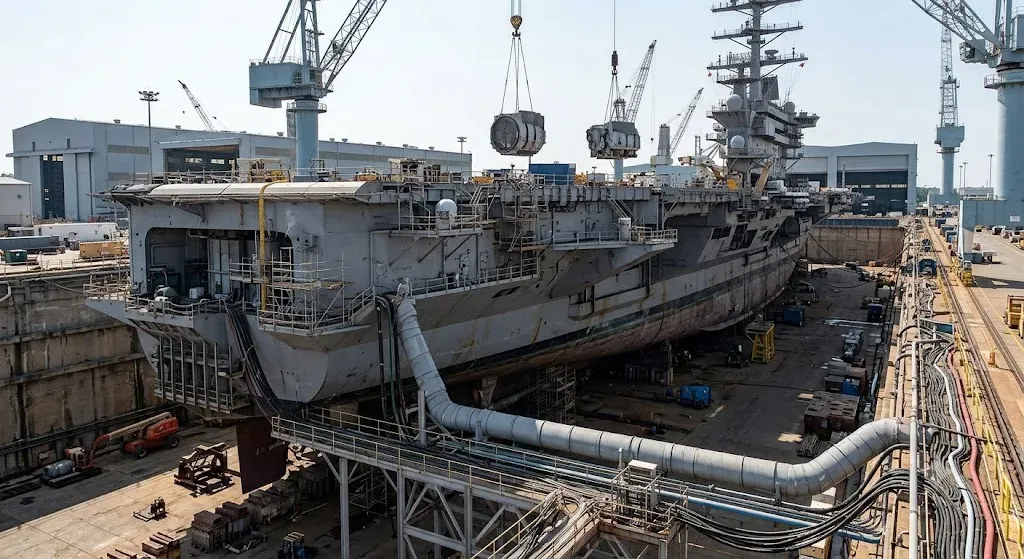
UNITED STATES OF AMERICA —A defense contract valued at approximately $5.10 billion with options extending total commitments to $5.18 billion, has been awarded to Huntington Ingalls Industries for mid-life recapitalization of the aircraft carrier USS Harry S. Truman (CVN 75). Executed through the firm's Newport News Shipbuilding unit, the Refueling and Complex Overhaul (RCOH) project encompasses a massive structural and technological modernization designed to prepare the vessel for its remaining quarter-century of operational service.
This multi-billion-dollar allocation represents the single largest maintenance milestone in a supercarrier's 50-year service lifecycle. Beyond replacing nuclear fuel within the ship's reactors, the overhaul involves comprehensive refitting across thousands of internal compartments and fuel tanks, alongside extensive modernization of propulsion systems, onboard electronics, and command combat networks. Huntington Ingalls Industries operates as the primary shipbuilder for the US military fleet, employing roughly 45,000 personnel and specialized facilities in Virginia to supply major naval surface combatants, submarines, and autonomous defense systems.
The execution of this RCOH underscores a sustained federal commitment to maintaining long-range naval power projection capabilities amid shifting global security dynamics. Large-scale defense procurements of this scale directly stimulate defense supply chains, delivering sustained long-term revenue visibility to specialized marine engineering contractors, equipment manufacturers, and technical defense vendors operating across North America.
For defense sector analysts and industrial investors, the agreement reinforces Newport News Shipbuilding as the sole industrial facility equipped to perform complex refueling overhauls on nuclear-powered aircraft carriers. The multi-year capital commitment ensures sustained industrial capacity, high-skilled labor retention, and technological modernizations across key maritime defense clusters, anchoring regional defense manufacturing stability for the coming decade.