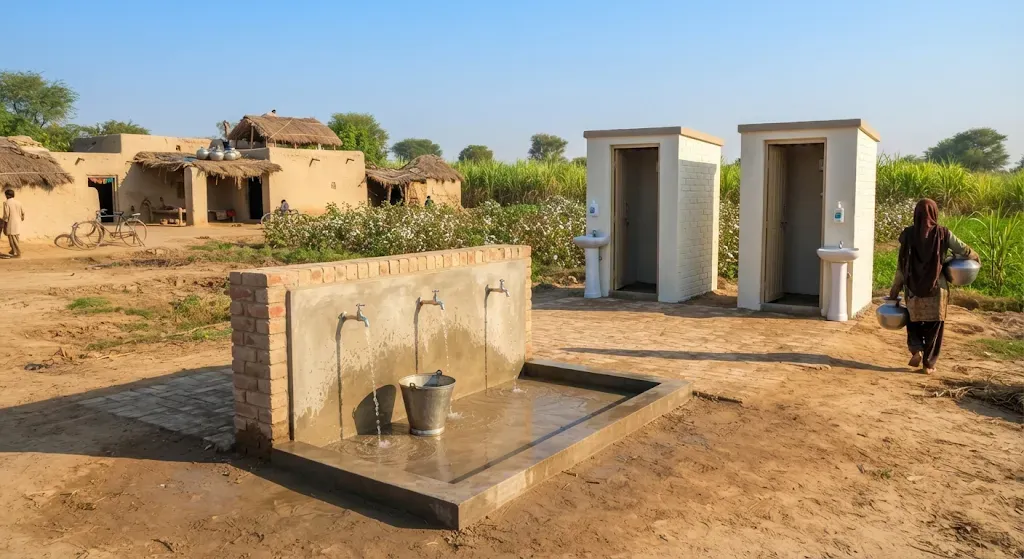
PAKISTAN —The World Bank Group (WBG) Executive Board has authorized a USD 300 million financing package for the Sindh Rural Water Supply, Sanitation and Hygiene (WASH) Project, targeting foundational water supply, sanitation, and hygiene improvements across designated rural areas of Sindh Province. This capital injection represents the first phase of a structured, multi-phase programmatic framework designed to transform regional utility models over a ten-year horizon. Additional financing for the initial phase includes contributions from the Asian Development Bank (ADB) and domestic counterpart funding, increasing the total capital allocated to the project.
Chronic exposure to contaminated water resources and inadequate sanitation infrastructure remains a primary contributor to widespread developmental stunting and recurrent waterborne illnesses among children residing outside metropolitan centers. Public health analyses indicate that foundational deficiencies in regional hygiene services severely constrain long-term cognitive and physical growth metrics, impairing overall human capital formation. The intervention strategy seeks to deploy climate-resilient engineering assets, such as solar-powered distribution networks, while simultaneously shifting administrative frameworks toward sustainable, utility-managed service delivery models to drastically lower water contamination rates.
Public sector initiatives and infrastructure modernization efforts within the region stand to gain significant momentum through this systemic overhaul. By establishing formal utility structures and expanding modern municipal services to underserved populations, the framework creates substantial employment opportunities within construction, engineering, and maintenance sectors. Furthermore, commercial entities operating within utility engineering and regional development will encounter expanded contracting avenues as subsequent phases of the long-term programmatic roadmap unfold.
Institutional investors and economic analysts view this large-scale deployment as a critical mechanism for mitigating structural socioeconomic vulnerabilities in developing markets. Enhancing basic infrastructure directly influences workforce productivity and regional stability, offering institutional stakeholders a reliable pathway for capital allocation aligned with international resilience objectives. Long-term market participants must monitor regulatory adjustments regarding utility corporatization and private sector participation in regional sanitation management to identify emerging commercial openings.