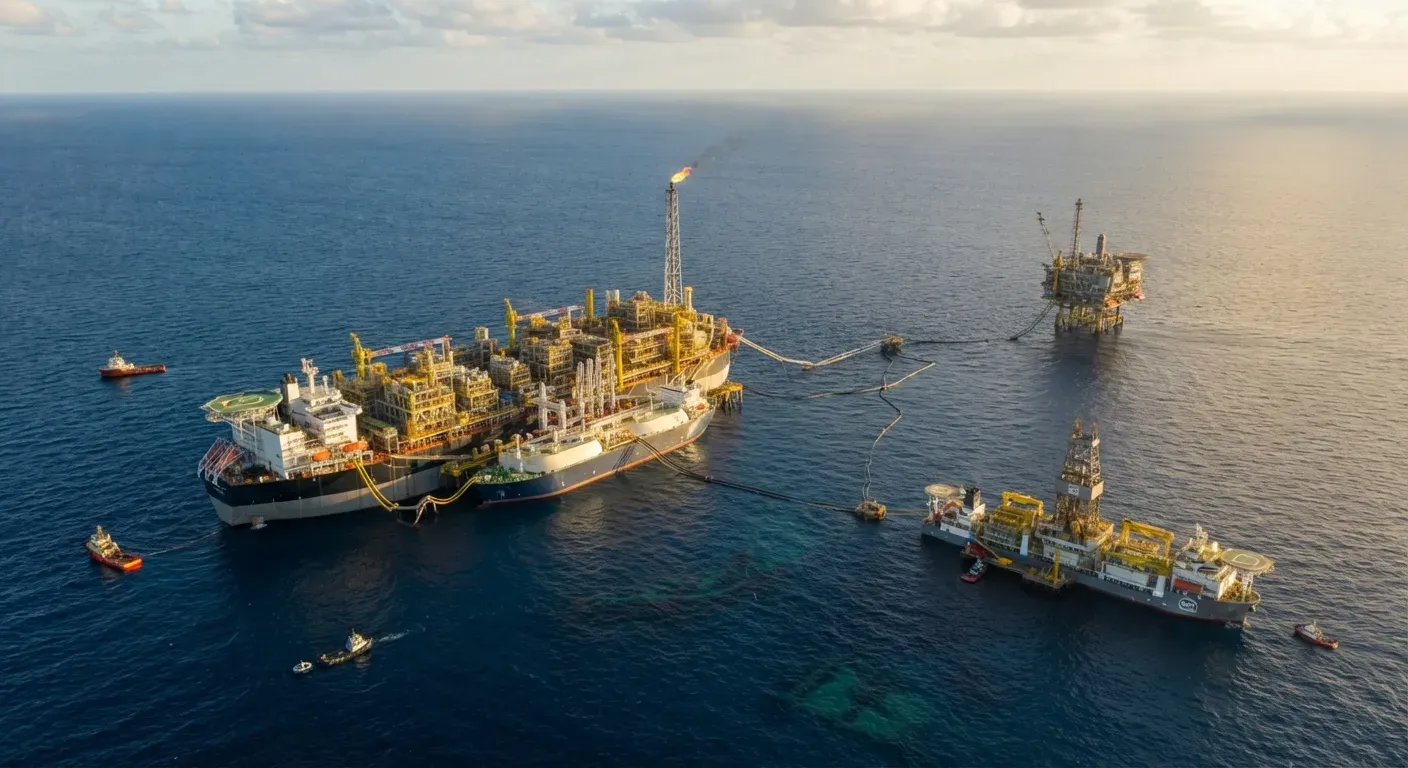
AUSTRALIA —Woodside Energy is advancing plans to raise its participating interest in the offshore Browse gas project to 41.27%, having exercised pre-emption rights in June 2026 according to its Capital Markets Day 2026 disclosures. Closing the transaction remains conditional on required government, regulatory, and joint venture approvals. The Browse development encompasses the Brecknock, Calliance, and Torosa fields located roughly 425 kilometers north of Broome in the Browse Basin off Western Australia.
Securing a larger equity share strengthens Woodside Energy's alignment over a major undeveloped resource holding gross 2C contingent resources of 14.4 trillion cubic feet of gas, 383.9 million barrels of condensate, and 27.1 million barrels of oil equivalent of natural gas liquids. Prior to completion of the stake increase, Woodside Energy's net share equals approximately 30.6% of those gross volumes, or 4.4 trillion cubic feet of gas, 117.5 million barrels of condensate, and 8.3 million barrels of natural gas liquids. Rather than building standalone greenfield liquefaction infrastructure, Woodside Energy is evaluating a three-train backfill concept routing Browse gas to existing North West Shelf facilities at the Karratha Gas Plant alongside offshore carbon capture and storage.
For the liquefied natural gas value chain, engineering and EPC contractors, subsea service providers, and carbon management developers, the backfill pathway highlights how brownfield processing capacity can be paired with emissions mitigation to unlock stranded offshore reserves. At the same time, progression depends on environmental and regulatory clearances, technical definition, and commercial and contractor agreements, keeping policy and permitting milestones central to project delivery in Western Australia.
Headquartered in Perth, Woodside Energy is Australia's largest independent oil and gas producer and trades on both the Australian Securities Exchange and the New York Stock Exchange. The North West Shelf project, which has supplied domestic gas since 1984 and liquefied natural gas since 1989, provides existing processing infrastructure that shapes capital efficiency and joint venture dynamics. For institutional investors and energy market participants, increasing concentration in Browse raises exposure to large-scale offshore gas development timelines, regulatory review cycles, and capital allocation discipline across long-dated LNG supply options.